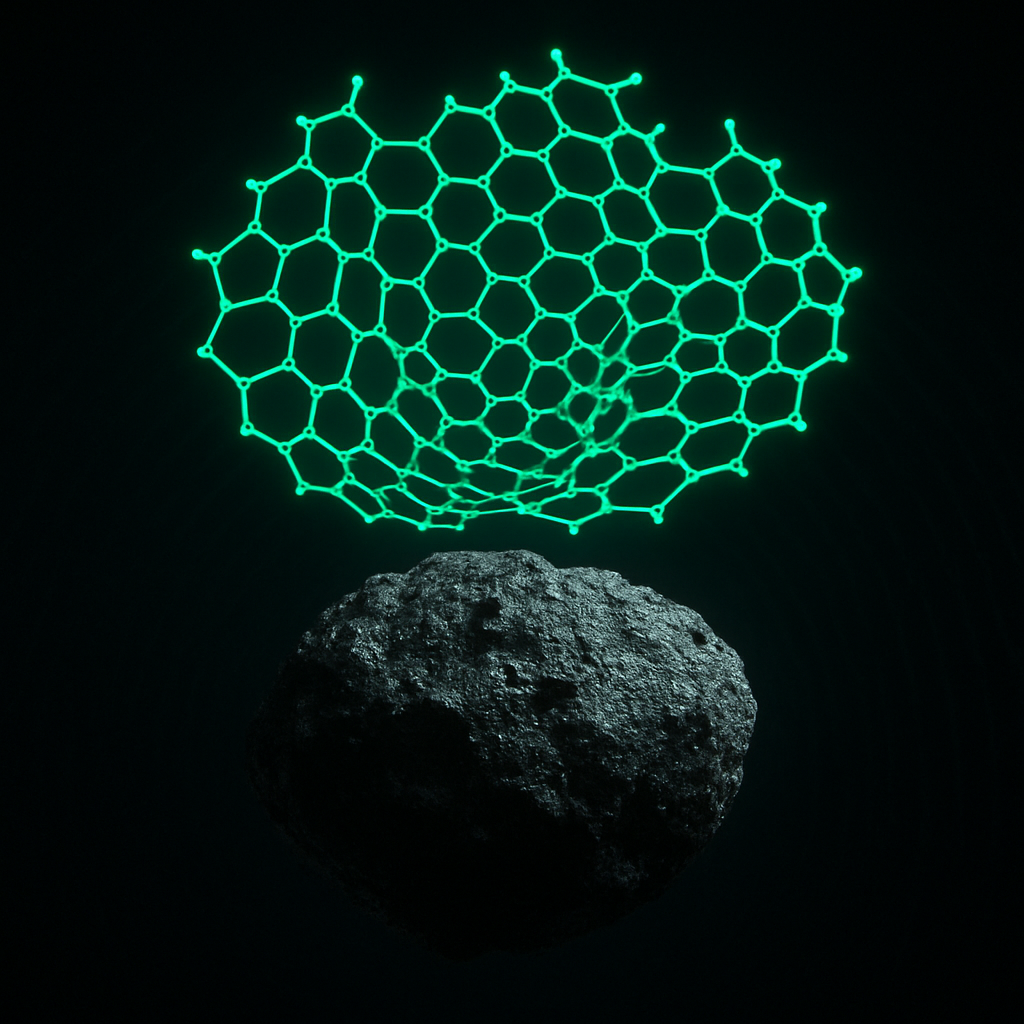
The 5.4 grams of charcoal-black regolith that JAXA’s Hayabusa2 dropped into the Australian outback in December 2020 are now the most productive grams in planetary science – and they are still producing. A research team led by the University of Tokyo, working with JAXA and collaborators, has used high-resolution atomic force microscopy to do something no one had done with extraterrestrial material at this fidelity: image individual organic molecules, one by one, rather than infer them statistically from a mass spectrometer’s ensemble readout. What the needle found defies the standing model of asteroid organics. Polycyclic aromatic hydrocarbons – thought from prior Ryugu analyses to be modest, mostly planar structures of a few rings – turn out to include giants: molecules with more than 100 fused rings and estimated molecular weights above 3,000, warped into curved, bowl-like, three-dimensional shapes by pentagonal, heptagonal, and even octagonal rings embedded in the hexagonal lattice. For the second time in three months, Ryugu has materially rewritten the organic inventory of C-type asteroids. OED’s read: the scientific compounding rate of returned-sample material is itself the asset – and it is quietly re-ranking targets, instruments, and missions across the Deep Space & Resources sector we score.
What was actually found – and why the technique is the story
Every previous organic survey of Ryugu material – including the uracil detection in 2023 and the complete-nucleobase result this March – relied predominantly on mass spectrometry: dissolve, ionize, weigh, and reconstruct what must have been there. Mass spectrometry is exquisitely sensitive but statistically blind to what it cannot ionize or what fragments on the way in. Very large macromolecules are exactly the population it under-samples. The Tokyo-led team instead deployed non-contact, high-resolution atomic force microscopy – the technique that produces those startling single-molecule photographs of pentacene and nanographenes – and scanned Ryugu’s insoluble organic fraction molecule by molecule.
The census came back strange. Alongside the expected small PAHs sat structures an order of magnitude larger than anything mass spectrometry had registered: fused-ring systems exceeding 100 rings, molecular weights past 3,000, and – critically – geometries that are not flat. The embedded five-, seven-, and eight-membered rings force curvature and twist into the carbon lattice, producing complex three-dimensional architectures closer to fragments of warped graphene or open fullerene cages than to the tidy planar PAHs of textbook astrochemistry. The team’s interpretation is that at least some of this population may be inherited intact from the interstellar molecular cloud that preceded the solar system – surviving 4.6 billion years of solar-system processing inside the parent body that became Ryugu.
Mass spectrometry told us what Ryugu’s molecules weigh. The microscope just told us what they look like – and they look nothing like the model.
Ring counts for meteoritic macromolecular material were previously inferred from bulk chemistry, not observed. The June 2026 AFM result is the first direct visual confirmation that individual macromolecules of this scale exist in asteroidal material – and that they are three-dimensional, not planar.
The Ryugu compounding curve – from grains to a research economy
Step back and the pattern is the signal. Hayabusa2 returned 5.4 grams in late 2020 – double-digit multiples of its 100-milligram requirement, but still a sample small enough to fit in a teaspoon. Five and a half years on, that teaspoon has produced: 20+ amino acids (2022); uracil and vitamin B3 (2023); evidence of aqueous alteration chemistry and ammonia-rich ices from an outer-solar-system reservoir; all five canonical DNA/RNA nucleobases with abiotic signatures (March 2026, covered in OED-FIB-2026-0318); and now directly imaged pre-solar-candidate macromolecules (June 2026). Each result multiplied the scientific – and strategic – valuation of the same fixed physical inventory. JAXA’s curation facility releases material in milligram allocations to competing international teams, and the queue keeps lengthening because the material keeps paying out.
Five major organic-chemistry results from one 5.4 g sample in 66 months – a discovery cadence no remote-sensing dataset has ever approached. The same curve is now starting for OSIRIS-REx’s 121.6 g Bennu inventory, which is 22× larger.
Why this matters beyond the lab – the sector read
OED scores the Deep Space & Resources sector across eight subsectors, and this result moves the needle in three of them. First, target characterization: the March nucleobase paper established that C-type asteroids are chemically individuated – each parent body runs its own organic synthesis pathway, modulated by ammonia availability and aqueous history. The AFM result deepens that: Ryugu’s insoluble organic fraction contains structural complexity (curvature, heteroring content, 3D architecture) that bulk chemistry cannot see, meaning two asteroids with identical bulk spectra can carry radically different molecular inventories. Remote sensing just lost more pricing power to returned samples. Second, instrumentation: single-molecule AFM now joins the short list of techniques that can extract this class of information, and it requires sample in hand – it cannot fly on a flyby. Third, mission architecture: the result strengthens the case for cheap, repeatable sample return over one-off flagship missions, because the value of returned mass compounds for decades after the spacecraft is scrap.
The science also tightens the origin-of-life supply chain argument that underpins long-horizon interest in carbonaceous targets. If macromolecules of this complexity pre-date the solar system and survive parent-body processing, then the delivery of deeply evolved organic feedstock to early planets is the default, not the exception – chemistry that any habitable world likely receives for free. That reframes C-type asteroids from “wet gravel with amino acids” to archives of pre-solar chemical evolution, with scientific franchise value that national agencies have shown they will fund across decades: Hayabusa2 cost roughly ¥28.9B (~$270M) and is still generating front-page results sixteen years after approval.
Remote sensing prices an asteroid by what it reflects. Sample return prices it by what it remembers. Ryugu just demonstrated the memory goes back further than the solar system.
Total carbonaceous asteroid material returned to Earth to date: ~127 g across two missions. Every gram is allocation-rationed across international research queues. The supply curve is missions; the demand curve is every astrobiology, astrochemistry, and ISRU program on Earth.
Competitive intelligence – who monetizes sample science
No company books revenue when a Nature Communications paper drops. But the result re-ranks the field OED tracks in Deep Space & Resources, because it shifts where the defensible value sits: in access to material, in flight-proven characterization, and in the ability to fly cheap missions to carbonaceous targets. The commercial cohort remains early – scores in this sector run low and risk runs Very High across the board – but the dispersion is informative. Karman+ (OED 42) is the most directly read-across name: its sub-$20M High Frontier mission to a carbonaceous NEA, with a water-extraction demo, is now flying toward targets whose organic complexity – and therefore scientific co-funding potential – just repriced upward. AstroForge (OED 48) deliberately targets M-type metallic bodies, insulating its platinum-group thesis from C-type science volatility but also excluding it from the organics franchise. TransAstra (OED 45) sells optical-mining water extraction wherever volatiles are; richer organic chemistry in C-types cuts both ways, complicating feedstock purity while strengthening the case that volatiles-rich targets are abundant. China’s Origin Space (OED 45) gains from CNSA’s Tianwen-2 momentum the way US firms gain from OSIRIS-REx heritage. The defunct pioneers – Planetary Resources and Deep Space Industries – remain the sector’s cautionary base rate: right thesis, wrong decade, dead a half-decade before the science caught up to the pitch.
| Player | Thesis | Capital | Ryugu-result exposure | OED Score |
|---|---|---|---|---|
| AstroForge | M-type PGM extraction (2022 OB5, Vestri) | $60M | Indirect – insulated from C-type science, excluded from organics franchise | 48 |
| Karman+ | Sub-$20M carbonaceous NEA sample return + water demo (High Frontier, 2026–27) | $20M | Direct – cheap C-type access is the scarcest capability the result repriced | 42 |
| TransAstra | Optical Mining™ volatiles extraction | $20M | Mixed – richer organics complicate feedstock, strengthen volatiles abundance case | 45 |
| Origin Space (CN) | Asteroid mining, NEO-01 telescope on orbit | $60M | Indirect – rides CNSA Tianwen-2 sample-return momentum | 45 |
| OffWorld | AI swarm mining robotics, Earth-first | $4.3M | Minimal – pre-space, hardware-agnostic to target chemistry | 35 |
| Asteroid Mining Corp (UK) | SCAR-E robotics, survey smallsat | $3M | Minimal – pre-flight | 30 |
| Planetary Resources | Pioneer – folded 2018 (ConsenSys) | $50M+ (sunk) | The base rate – right thesis, ~15 years early | – |
| Deep Space Industries | Pioneer – folded 2019 (Bradford) | $10M (sunk) | Ditto – water-propulsion tech survived via acquisition | – |
Sector scores are low-band by construction: pre-revenue, Very High risk, decade-plus payback. The Ryugu result does not change any company’s cash position – it changes which capabilities (C-type access, sample handling, cheap return architecture) compound in value while the commercial market waits to exist. Karman+ is highlighted as the highest-beta name to this specific result.
The agency layer – where the franchise actually sits
The uncomfortable truth for the commercial cohort is that the sample-science franchise is, today, a sovereign asset. JAXA turned a ~$270M mission into a sixteen-year discovery annuity and is already running the sequel: Hayabusa2’s extended mission (Hayabusa2#) executes a ~5 km/s, sub-kilometer flyby of asteroid (98943) Torifune on July 5, 2026, around 18:30 JST – three weeks from this brief – en route to a 2031 rendezvous with the fast-rotating 1998 KY26. NASA’s OSIRIS-APEX is inbound to Apophis for the 2029 close approach. CNSA’s Tianwen-2 is outbound to Kamo’oalewa with a ~2027 return window. Each of these missions extends the inventory of characterized or returned material, and each return event historically front-runs a multi-year discovery cycle of exactly the kind Ryugu is demonstrating. For OED’s scoring model, agency sample-return cadence functions as the sector’s R&D budget – capital the startups do not have to spend, generating the target intelligence they will eventually mine against.
OED maintains Deep Space & Resources sector scoring unchanged this cycle: the result is science-positive but cash-neutral for all tracked entities. Karman+ flagged for potential re-rating on High Frontier mission progress; sector-wide re-rating contingent on Tianwen-2 return execution.
OED’s view
We wrote in March that organic chemistry had become a measurable axis for differentiating asteroid targets. June’s result hardens that thesis and adds a second one: the analytical instrument layer is becoming strategic. The discovery was not made by a new spacecraft, a new sample, or a new budget line – it was made by pointing a better microscope at six-year-old material. That is the highest-leverage dollar in the sector right now, and it implies the value chain runs: returned mass → curation access → instrument capability → published characterization → target selection for every future commercial mission. Entities positioned at any link of that chain – JAXA’s and NASA’s curation facilities, the AFM/instrumentation groups, and the single commercial player (Karman+) attempting to add returned C-type mass on a startup budget – hold appreciating assets. The asteroid mining cohort’s pitch decks have claimed for a decade that asteroids are archives of the early solar system. Ryugu’s grains keep upgrading that claim: the archive now provably predates the solar system, the reading technology finally exists, and the library holds 127 grams against a queue of every laboratory on Earth. Scarcity like that always finds a price.
Sixteen years after approval, Hayabusa2 is still generating front-page science from a teaspoon of gravel. No flagship in the OED database has a better discovery-per-gram ratio – and the gram supply is the entire bottleneck.