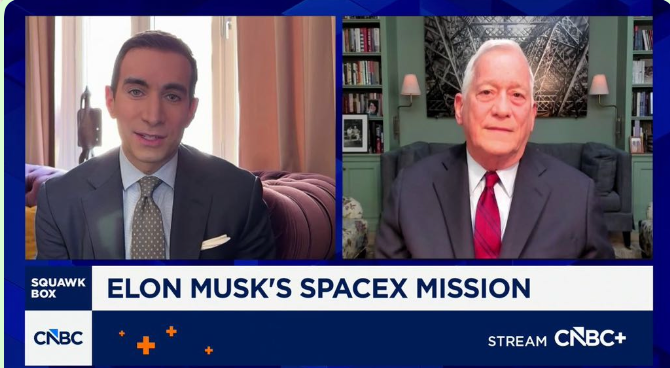
At 10:00 a.m. Eastern this morning, SpaceX begins trading on the Nasdaq – and, in a first, on Nasdaq Texas – under the ticker SPCX, at an offer price of $135 per share that values the company at approximately $1.77 trillion and raises on the order of $75 billion. Every superlative in financial journalism has already been spent on this listing, so we will be economical with ours: it is the largest IPO ever priced, for the most consequential aerospace company since the 1960s, arriving with financials – $18.7 billion in fiscal 2025 revenue, $6.6 billion in adjusted EBITDA, 10.3 million Starlink subscribers across 164 countries – that were, until three weeks ago, one of the most carefully guarded data sets in private markets. But the most clarifying thing said about this morning did not come from a banker. It came from Walter Isaacson, Musk’s biographer, on CNBC’s Squawk Box: “It’s not that you’re just getting a trillionaire, it’s that you’re getting a whole new economy – the space economy.” We started Off Earth Data on precisely that premise. Today the market gets its first liquid, daily-marked claim on that economy. Our caution – offered humbly, because today belongs to the company – is that one ticker is not an economy, any more than one iceberg tip is the ice.
What actually priced last night
The mechanics deserve a sober reading, because they will set the template for every space listing that follows. SpaceX is selling 555,555,555 shares of Class A common stock – the numerology is presumably intentional – at $135.00, with an additional European retail tranche of up to 55,555,555 shares, a structure that treats global retail demand as a strategic constituency rather than an afterthought. The company retains a dual-class structure in which Class B shares carry ten votes each, preserving founder control in the manner of Meta and Alphabet before it. Proceeds, per the S-1 filed 20 May, are earmarked substantially for what the company describes as an AI initiative, with Starlink explicitly cast as the financial engine – a detail we believe deserves more attention than it has received, because it means the world’s largest IPO is, on its own telling, a financing event for compute as much as for rockets.
The S-1 also quantified what observers had estimated for years: Starship absorbed $3.0 billion in R&D during fiscal 2025 and $930 million in the first quarter of 2026 alone, with the first commercial orbital payload targeted for the second half of this year. The filing confirms the basic shape long inferred by analysts – launch is the moat, Starlink is the business, and Starship is the bet.
Pricing and share counts per final terms reported ahead of the 12 June open. Valuation reflects the offer price; the market will set its own number at 10:00 a.m.
“It’s not that you’re just getting a trillionaire, it’s that you’re getting a whole new economy – the space economy.”
– Walter Isaacson, CNBC Squawk Box, 12 June 2026, ahead of the SPCX open
The Isaacson thesis, assessed
Isaacson has been building this argument across a month of appearances: that a SpaceX listing may presage a consolidation of Musk ventures into a single entity, and – more provocatively – that by 2027 the space economy could occupy the place in the market’s imagination that artificial intelligence occupies today. As researchers, we are obligated to separate the falsifiable from the rhetorical. The consolidation claim is unfalsifiable until it happens, though the dual-class structure and AI-centric use of proceeds are consistent with it. The “space is the new AI” claim is better treated as a statement about capital flows than about technology: AI became “AI” as an asset class when public investors got liquid instruments with which to express the view. Space, until 10 a.m. this morning, had no instrument remotely adequate to the thesis. Now it has one – and that is exactly the problem we want to flag.
A single ticker that bundles launch, broadband, defense contracting, and a pre-revenue Mars program into one $1.77 trillion claim will become, by default, the index of the space economy. It is a bad index. It is a magnificent company and a bad index – the way owning only Standard Oil was a bad index of industrialization. The space economy that Isaacson is describing is broader, stranger, and mostly invisible from the public markets.
The iceberg: what the ticker tape cannot see
Here is the arithmetic that motivated us to build OED in the first place. Our database currently tracks more than 3,300 entities across 26 sectors and 110+ subsectors of the space economy, spanning 12 spacefaring nations and compiled from 70+ live data sources – from Launch Services and Satellite Communications through In-Space Servicing, Space-Based Computing, Lunar ISRU, Orbital Refueling, and Space Nuclear. Of those 3,300-plus entities, roughly two dozen trade on a public exchange as pure-play space names. That is fewer than one in a hundred. Everything else – the propulsion suppliers, the ISAM startups, the orbital data-center ventures, the asteroid-sample instrument makers, the lunar logistics primes-in-waiting – sits below the waterline: privately held, sparsely disclosed, and invisible to anyone whose map of the sector is a brokerage watchlist.
SPCX makes the visible tip taller without making the iceberg smaller. Indeed it makes the distortion worse in one specific way: index weight. A $1.77 trillion space company entering public benchmarks will dwarf the combined float of every other public space name – Rocket Lab, AST SpaceMobile, Intuitive Machines, Redwire, Planet, Voyager, EchoStar and the rest sum to a small fraction of it. Passive flows tracking “space” will, mechanically, be flows tracking SpaceX. The diversification the sector needs will have to come from below the waterline, over years, through exactly the kind of listings – Quantum Space’s SPAC this week, Voyager’s IPO last June – that our coverage has been documenting one by one.
Counts from the OED Comprehensive Database: 3,300+ entities across 26 sectors, 110+ subsectors, and 12 spacefaring nations, compiled from 70+ data sources including SEC EDGAR, SAM.gov, ITU filings, Crunchbase, PitchBook, and company IR. Public count includes pure-play and majority-space-revenue listed names tracked on the OED dashboard; diversified primes (Boeing, Lockheed Martin, Airbus) are tracked but not counted as pure-play public space exposure. The public bar is drawn at 1.5% width as a visibility floor – the true proportion is smaller.
Beyond launch: three sectors the listing quietly reprices
Satellite communications. The S-1’s confirmation that Starlink generates the majority of SpaceX revenue converts the satcom sector’s central anxiety into a public, auditable number. For AST SpaceMobile, EchoStar, Eutelsat-OneWeb, and Amazon’s Leo, the read-through cuts both ways: Starlink’s 10.3 million subscribers validate the demand curve for space-delivered broadband at a scale no analyst model dared assume in 2020, while simultaneously demonstrating the punishing capital intensity of competing – SpaceX needed its own rockets, its own factory, and six years of deployment to get here. Our Satellite Communications coverage has long carried the highest concentration-risk flag in the database. A public Starlink P&L, disclosed quarterly, will now discipline every constellation business plan on Earth – and every one of them will be benchmarked against it in pitch meetings from Toulouse to Bangalore.
Space-based computing. The strangest and most forward-leaning disclosure in the S-1 is the AI initiative itself – proceeds from a rocket company’s IPO directed toward compute, with Starlink as the cash engine. Read alongside SpaceX’s FCC filing contemplating up to a million compute-bearing satellites, and alongside this week’s coverage of Orbital’s $5 million pre-seed and Starcloud’s $1.1 billion valuation in our Space-Based Computing sector, the signal is unmistakable: the largest player in space believes the next decade’s marginal dollar is earned by putting silicon, not just bandwidth, in orbit. The companies we track in that sector just acquired the most powerful possible validator – and the most dangerous possible competitor.
In-space mobility and infrastructure. Starship’s $3.9 billion of disclosed R&D over five quarters resets the cost baseline for everything downstream of launch. If a fully reusable heavy-lift vehicle flies commercial payloads in the second half of 2026, the binding constraint across our In-Space Servicing, Orbital Refueling, and Space Stations & Habitats sectors shifts from “can you afford to get there” to “what do you do once mass is cheap.” That is the world Quantum Space, Impulse, Astroscale, and the depot builders have been engineering for – on Tuesday we called it the cislunar layer; today the market capitalized its enabling assumption at $1.77 trillion.
The sympathy tape
The sector has been trading the listing for weeks. The VanEck Space ETF (WARP) gained 24 percent in the five sessions following the S-1 filing in May, and yesterday’s pricing sent AST SpaceMobile, Rocket Lab, Redwire, and EchoStar higher again in pre-market action this morning. We note, with the appropriate humility of people who watch this tape daily, that sympathy rallies around mega-listings historically decay once the anchor begins trading and index flows resolve – the relevant precedent set is small, and a $1.77 trillion debut has no precedent at all.
| Company | Ticker | OED Score | Posture into the open | Primary SPCX read-through |
|---|---|---|---|---|
| SpaceX | SPCX | 98 | Opens 10:00 a.m. ET | The instrument itself |
| Rocket Lab | RKLB | 88 | Bid up into pricing | Only other vertically integrated launch + systems comp |
| AST SpaceMobile | ASTS | 68 | Bid up into pricing | Starlink D2C numbers validate – and threaten – the model |
| Redwire | RDW | 62 | Bid up into pricing | Infrastructure beta to cheap mass on orbit |
| EchoStar | SATS | 55 | Bid up into pricing | Spectrum scarcity value re-rated by Starlink disclosure |
| VanEck Space ETF | WARP | – | +24% in 5 sessions post-S-1 | Sector beta; SPCX index inclusion pending |
OED scores from the OED Comprehensive Database. Pre-market moves per market reports this morning; figures will be stale by the time you read this, which is rather the point of a 10 a.m. open.
Why we built OED – said plainly, once
We do not ordinarily editorialize about ourselves, and we will keep this short. Off Earth Data exists because the space economy’s information layer has been inverted for a decade: the most economically significant companies disclosed the least, while the public names – a couple dozen tickers, many of them SPAC survivors – were asked to stand in for an entire industrial transition. Our response was to track everything we could see regardless of listing status: 3,300+ entities, 26 sectors, 110+ subsectors, government programs included, refreshed against 70+ live data sources. This morning, the single most informative private company in the world moved above the waterline. We regard that as vindication of Isaacson’s framing and ours – and as a reminder that more than 99 percent of the iceberg is still down there, which means the work is not finishing today. It is starting.
What to watch from here
The open itself – whether SPCX holds $135 and where the market sets the first public mark on the space economy’s anchor asset. Index inclusion timelines – S&P eligibility rules around dual-class structures and float will determine how fast passive money arrives. The first 10-Q – a quarterly Starlink disclosure cadence begins now, and every constellation operator’s cost of capital will move with it. Starship’s first commercial orbital payload, targeted for H2 2026 – the operational event that converts the S-1’s biggest line item from bet to business. And the listing pipeline – if SPCX trades well, the queue of private space companies eyeing the public door (we track more than 3,200 of them) gets meaningfully shorter. We will be watching all of it, from below the waterline up.